Tree removal in Maple Valley: Average Pricing, Permits
TL;DR: Tree removal in Maple Valley typically costs between $300-$3,000+ depending on tree size, location, and complexity. While many residential tree removals don't require permits, properties near critical areas (streams, wetlands, steep slopes) or involving significant trees may need city approval. MTS Tree & Landscape offers licensed, insured arborist-led services with free estimates, full cleanup, stump grinding, and 24/7 emergency response for storm-damaged trees throughout South King County.
Key Takeaways
- Average Cost Range: Small tree removal starts around $300-$800; medium trees $800-$1,500; large or hazardous removals $1,500-$3,000+
- Permit Requirements: Maple Valley and King County regulate tree removal in environmentally critical areas and for certain significant trees—many residential removals don't require permits, but site-specific assessment is essential
- Power Line Safety: Never attempt DIY tree work near overhead lines; professional services coordinate with utilities and follow OSHA safety standards
- Stump Grinding: Typically an add-on service ranging $75-$400+ depending on stump diameter and accessibility
- Insurance Coverage: Homeowner's insurance often covers tree removal when trees damage structures or block access, but not preventative removal
- Emergency Services: 24/7 rapid response available for storm-damaged trees on roofs, vehicles, or blocking driveways
When you're standing in your Maple Valley yard looking at a dead, leaning, or dangerously overgrown tree, the questions start piling up fast. How much is this going to cost? Do I need to pull a permit from the city? Is it even safe to remove a tree that close to power lines? And if a storm just knocked a massive branch onto my roof, who can get here quickly?
These aren't just practical concerns—they're exactly the questions every responsible homeowner should ask before hiring someone to remove a tree from their property. Tree removal isn't a simple weekend DIY project. It requires specialized equipment, trained crews, proper insurance, and knowledge of local regulations that protect both your property and Maple Valley's urban forest.
In this guide, we'll walk through everything Maple Valley homeowners need to know about tree removal: realistic pricing, when permits are required, safety protocols for trees near power lines and structures, what happens to stumps and debris, insurance considerations, and how to find a licensed arborist you can trust. Whether you're dealing with an emergency situation or planning a landscape renovation, you'll have the information you need to make confident decisions.
MTS Tree & Landscape has served Maple Valley and South King County since 2005 as a family-owned, licensed, bonded, and fully insured tree service. Our arborist-led crews handle everything from routine removals to complex hazardous tree situations, always with a focus on safety, transparency, and complete cleanup.
Get Your Free Tree Removal Estimate →
How Much Does Tree Removal Cost in Maple Valley?
Let's cut straight to the question every homeowner asks first: "How much is this going to cost me?"
Tree removal pricing in Maple Valley varies significantly based on several key factors, but understanding the typical ranges helps you budget appropriately and recognize when an estimate seems unusually high or suspiciously low.
Typical Price Ranges for Maple Valley Tree Removal
Small trees (under 30 feet): $300-$800 These include ornamental trees, young maples, smaller dogwoods, and landscape plantings that haven't reached full maturity. Removal is typically straightforward with minimal rigging required.
Medium trees (30-60 feet): $800-$1,500 This category includes many mature landscape trees—established maples, mid-sized firs, and similar species. Removal requires more careful planning, sectional cutting, and controlled lowering of larger limbs.
Large trees (60-80+ feet): $1,500-$3,000+ Mature Douglas firs, large maples, old growth conifers, and other substantial trees fall into this range. These removals demand experienced climbers, advanced rigging systems, and sometimes crane assistance.
Hazardous or complex removals: $2,500-$5,000+ Trees leaning over structures, entangled in power lines, growing on steep slopes, or in extremely tight access areas require specialized techniques, additional crew members, and extended time on site.
What Drives Tree Removal Costs?
- Tree size and species: A 25-foot ornamental cherry comes down much faster than an 80-foot Douglas fir. Height isn't the only factor—canopy spread, trunk diameter, and wood density all affect removal complexity and time requirements.
- Location and access: A tree in an open backyard costs less to remove than one wedged between your house and fence line. If equipment can't reach the site, everything must be carried out by hand, increasing labor costs significantly.
- Proximity to structures and utilities: Trees hanging over roofs, close to power lines, or threatening fences and neighboring properties require meticulous rigging and controlled dismantling. Each piece must be carefully lowered rather than simply dropped, adding substantial time and technical difficulty.
- Condition and stability: Dead, diseased, or structurally compromised trees present additional hazards. Climbers can't trust weakened branches and limbs may break unpredictably, requiring extra safety precautions and slower, more deliberate work.
- Time sensitivity: Emergency tree removal Maple Valley WA services typically command premium pricing due to after-hours availability, rapid response requirements, and the urgent nature of storm damage situations.
- Stump grinding and debris removal: Basic tree removal usually includes cutting the tree to ground level and hauling away all wood and branches. Stump grinding is typically quoted separately, ranging from $75 for small stumps to $400+ for large, difficult-to-access stumps.
Why Free Written Estimates Matter
At MTS Tree & Landscape, we never quote tree removal over the phone. Every property is unique, and factors that significantly impact pricing—slope, access, nearby structures, power lines, tree condition—can only be properly assessed on site.
We provide free, no-obligation written estimates that break down exactly what's included: tree removal, stump grinding if requested, complete debris cleanup and haul-away, and any special considerations your specific situation requires. You'll know precisely what you're paying for before work begins, with no surprise charges after the job is complete.
Transparent, line-item pricing protects both homeowners and contractors. It ensures you're comparing apples to apples when getting multiple bids, and it holds service providers accountable for delivering exactly what they promised.
Schedule Your Free On-Site Estimate Today →
Do You Need a Permit to Remove a Tree in Maple Valley?
This is probably the second most common question we hear, and the answer is genuinely "it depends"—but we can help you navigate the factors that determine whether your tree removal requires city approval.
Understanding Maple Valley and King County Tree Regulations
Maple Valley operates under King County's development and environmental regulations, which means tree removal permits depend largely on your property's location and the tree's characteristics rather than a blanket rule that all removals require permits.
When permits are typically NOT required:
- Small ornamental and landscape trees on residential lots in developed areas
- Trees clearly hazardous to structures or personal safety
- Invasive species like Scotch broom or certain non-native invasives
- Standard residential landscape maintenance on lots not in critical areas
When permits are MORE LIKELY required:
- Trees on properties within or near environmentally critical areas (steep slopes over 40%, streams, wetlands, landslide hazard zones)
- "Significant trees" as defined by local code—typically trees over certain diameter thresholds
- Street trees or trees within city right-of-way
- Properties in specific overlay zones or HOA-governed communities with additional tree protection rules
- Vegetation removal associated with development, grading, or construction permits
Critical Areas and Tree Protection
South King County's landscape includes streams, wetlands, and steep slopes where vegetation plays crucial roles in erosion control, water quality protection, and habitat preservation. Properties in or near these critical areas face stricter tree removal regulations designed to protect ecological functions.
If your Maple Valley property borders Lake Wilderness, sits on a significant slope toward Jenkins Creek, or includes wetland areas, tree removal likely requires review by the city's planning department or even a critical areas study prepared by a qualified professional.
How MTS Helps Navigate Permit Requirements
Here's the good news: you don't have to figure this out alone. When we provide your free on-site estimate, we assess whether your specific tree removal likely needs a permit based on property location, tree characteristics, and our experience with local regulations.
If a permit appears necessary, we can:
- Guide you through the application process
- Provide documentation and site plans the city may require
- Coordinate timing so work proceeds legally and smoothly
- Connect you with professionals who can prepare required studies if needed
It's important to note that we can't provide legal advice, and regulations do change. When in doubt, we recommend contacting Maple Valley's Development Services Department directly or visiting their website for current tree removal requirements specific to your address.
What we strongly advise against: removing trees without checking permit requirements. If a tree was removed illegally, the city can require expensive replanting, issue stop-work orders on other projects, and levy significant fines. A quick check on the front end prevents major headaches later.
Safety and Trees Near Power Lines
If there's one area where DIY tree work turns genuinely life-threatening, it's anywhere near overhead electrical lines. This isn't just about property damage or botched jobs—contact between trees and power lines can be instantly fatal.
Why Power Line Tree Work Requires Professionals
Electricity doesn't require direct contact to jump from a power line to a conductive object like a tree, chainsaw, or person. Depending on voltage and conditions, electricity can arc several feet through the air. Even lines you think are "dead" may be energized, and distinguishing telephone/cable lines from power lines isn't always obvious from the ground.
Washington State law and OSHA regulations are crystal clear: only specifically trained and qualified personnel may work within 10 feet of power lines, using specialized equipment, techniques, and safety protocols.
How Licensed Arborist Maple Valley Teams Handle Power Line Situations
When you call MTS Tree & Landscape for a tree removal near power lines, here's our safety-first approach:
Assessment: We evaluate proximity to lines, voltage level (distribution lines are different from transmission lines), and whether the tree or branches are already in contact with wires.
Utility coordination: For trees touching or immediately threatening power lines, we coordinate with Puget Sound Energy or your utility provider. In many cases, the utility will de-energize lines or handle the portions of the tree directly contacting wires before we proceed with removal.
Proper clearances: Our crews maintain required safety distances from energized lines throughout the job, using non-conductive rigging and equipment where appropriate, and ensuring no portion of the tree being removed swings into the power line corridor.
Specialized training: Tree work near power lines requires specific qualifications beyond standard arborist training. Our crew members working in these situations maintain current certifications in electrical hazards awareness and line clearance techniques.
What About Service Drop Lines to Your House?
The power lines running from the utility pole to your home's weather head (service drop) present unique considerations. While lower voltage than main distribution lines, they still carry deadly current. Trees growing into or around service drops need professional attention—never attempt to cut branches away from these lines yourself.
In some cases, the utility company will temporarily disconnect your service drop to allow safe tree removal, then reconnect after the work is complete. We coordinate these logistics as part of our comprehensive approach to hazardous tree removal south king county properties.
Need Safe Power Line Tree Removal? Contact Us →
What Happens to the Stump and Debris After Removal?
Once the tree is down, what's left? Understanding what's included in "tree removal" versus additional services helps you plan appropriately and avoid surprises.
Standard Tree Removal Scope
When MTS provides tree removal service, our standard scope includes:
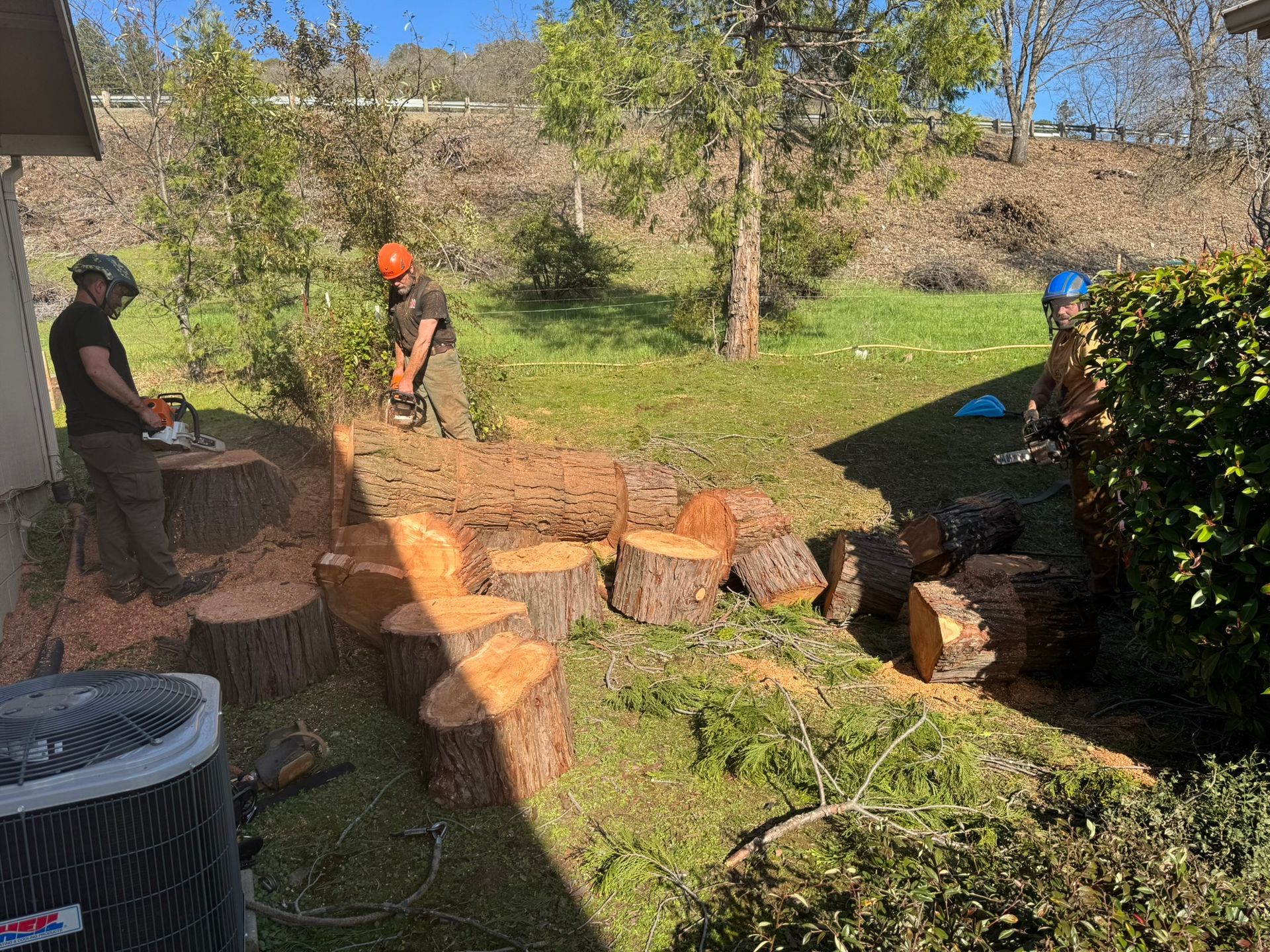
Tree dismantling: Safely cutting down or sectionally dismantling the tree, whether that's felling it in one piece in an open area or carefully rigging down each limb and trunk section in a confined space.
Debris processing: Chipping smaller branches and foliage, cutting larger wood into manageable pieces, and organizing material for removal.
Complete haul-away: Loading all wood, chips, and debris into trucks and removing it from your property. Your yard is left clean, not buried under piles of branches and sawdust.
Cutting to ground level: We cut the trunk as close to ground level as equipment safely allows—typically within a few inches of grade.
Stump Grinding: The Next Step
Here's what standard tree removal doesn't include: getting rid of the stump and root system below ground. That's where tree removal and stump grinding maple valley services come in as a separate but commonly requested add-on.
What is stump grinding? Stump grinding uses a specialized machine with a rotating cutting wheel to grind the remaining stump into wood chips, typically 6-12 inches below grade. This eliminates the tripping hazard, prevents new sprouts from emerging, and allows you to replant, lay sod, or develop the area however you'd like.
Stump grinding costs: Pricing depends on stump diameter, how many stumps you need ground, accessibility for the grinding equipment, and whether you want the grindings removed or spread as mulch. Small stumps might cost $75-$150, while large stumps in difficult locations can reach $300-$400 or more.
Why not just leave the stump? Some homeowners choose to leave stumps, especially in natural areas or wooded lots. But in landscaped yards, stumps create several issues:
- They're unsightly and interfere with lawn care and landscaping plans
- Many tree species will send up new shoots from the stump, requiring ongoing maintenance
- Decaying stumps attract insects including carpenter ants and termites
- They present tripping hazards, especially as grass grows around them
- They prevent full use of the area for future planting or construction
What Happens to the Wood?
Different homeowners have different preferences:
Standard removal: We haul all wood and debris off-site to recycling facilities where it's chipped for mulch, processed for biomass energy, or milled for lumber depending on species and size.
Firewood cutting: If you'd like usable wood cut to firewood length and stacked on your property, we can accommodate that request for certain species (fir, maple, alder). We typically cut to 16-inch lengths and stack where you direct—seasoning and splitting are then on you.
On-site chipping: Branch material can be chipped and left as mulch for your landscape beds if you prefer, reducing waste and providing free mulch for your property.
Log retention: Some homeowners want large trunk sections left for milling, woodworking projects, or natural seating elements in their landscape.
Just let us know your preferences when we're preparing your estimate, and we'll structure the job accordingly.
Insurance and Storm-Related Tree Removal
When a winter windstorm sends a tree crashing onto your roof or driveway, questions about insurance coverage add stress to an already difficult situation. Here's what you should know about insurance and tree removal.
When Insurance Typically Covers Tree Removal
Most homeowner's insurance policies include coverage for tree removal in specific circumstances:
- Tree damage to covered structures: If a tree falls and damages your house, garage, fence, or other covered structure, your policy generally covers removal of the portion of the tree that's causing or threatening additional damage. Coverage limits vary—many policies cap tree removal at $500-$1,000 per tree, though this is separate from the structure damage claim.
- Blocked access: Some policies cover removal when a fallen tree blocks your driveway or the only access route to your home, even if no structure was damaged.
- Named perils: Coverage typically applies when trees fall due to covered events like windstorms, lightning, weight of ice/snow, or vehicles striking the tree. Most policies won't cover trees that gradually fell due to rot or age.
When Insurance Doesn't Cover Tree Removal
Understanding coverage limitations prevents frustration:
- Preventative removal: Insurance doesn't pay to remove hazardous but still-standing trees, even if they're clearly at risk of falling. This is considered property maintenance, not a covered loss.
- Trees falling in your yard: If a tree falls but doesn't damage a structure or block access, removal is typically your responsibility as a homeowner.
- Negligence or lack of maintenance: If an insurer determines you failed to properly maintain trees and that neglect led to the failure, they may deny the claim.
How MTS Supports Insurance Claims
When you need emergency tree removal Maple Valley WA response after a storm, we understand insurance documentation matters:
- Detailed invoicing: We provide clear, itemized invoices breaking down labor, equipment, and disposal costs.
- Photo documentation: Our crews photograph damage conditions before, during, and after work when requested.
- Damage assessment: While we can't adjust claims, we can provide professional observations about what caused the tree failure and what damage resulted.
- Direct billing: In some cases, we can work directly with your insurance company on approved claims, reducing your out-of-pocket expenses.
- Important note: Always contact your insurance company before removing a fallen tree if you intend to file a claim. They may want to inspect the damage first, and premature removal could complicate your claim.
Emergency Tree Removal in Maple Valley
Storm season in the Pacific Northwest brings high winds, heavy snow, and ice—all of which can turn healthy-looking trees into immediate hazards in a matter of hours.
When You Need Emergency Response
Emergency tree removal situations include:
- Trees or major limbs on structures: When a tree has fallen onto your house, garage, or shop, further damage can occur with every gust of wind or additional precipitation. Emergency crews work to stabilize the situation, prevent additional damage, and safely remove the tree.
- Trees on vehicles: A tree crushing your car in the driveway requires careful removal to avoid causing additional damage during the extraction process.
- Blocked access: Trees across driveways, streets, or the only route in or out of your property need rapid clearing, especially in medical emergencies or when blocking multiple households.
- Hanging hazards: Partially failed trees or large limbs caught in other trees ("widow makers") present extreme danger until professionally removed. These situations can't wait for regular business hours.
- Trees threatening power lines: When trees fall into or are about to fail into power lines, they create fire hazards and electrocution risks requiring immediate professional attention coordinated with utility companies.
MTS Emergency Tree Service Response
When you call MTS Tree & Landscape for emergency assistance, here's what happens:
Rapid call-out: We maintain 24/7 emergency availability for maple valley tree removal service needs. During major storm events, we triage calls to address the most dangerous situations first.
Safety assessment: Our first priority is making the site safe—securing unstable portions, establishing safety zones, and coordinating with utilities if power lines are involved.
Stabilization and removal: We work to prevent further damage, then systematically remove the failed tree. In cases where immediate full removal isn't safe or practical (such as overnight in severe weather), we'll stabilize the situation and return to complete the work when conditions improve.
Full cleanup: Even in emergency situations, we complete thorough cleanup and debris removal, leaving your property safe and orderly.
Emergency Pricing
Emergency tree removal costs more than scheduled work due to after-hours availability, rapid response requirements, and the hazardous conditions often present. However, preventing additional damage to structures typically far outweighs the premium for immediate response.
We provide clear communication about pricing before beginning work whenever possible, though in true emergencies where property and safety are at immediate risk, stabilizing the situation takes priority over detailed estimates.
24/7 Emergency Tree Removal Hotline →
Finding a Licensed Arborist and Tree Removal Service in Maple Valley
Not all tree services are created equal, and choosing the wrong contractor can lead to property damage, personal injury, or incomplete work. Here's how to identify qualified professionals.
Essential Credentials and Qualifications
Washington State contractor's license: Legitimate tree services must be licensed contractors in Washington. This isn't optional—it's legal requirement. Verify license status through the Washington State Department of Labor & Industries.
Bonding and insurance: Comprehensive liability insurance protects your property if something goes wrong. Workers' compensation insurance protects you from liability if a crew member is injured on your property. Bonding provides additional financial protection. Always ask for proof of current coverage and verify it directly with the insurance company.
ISA certification: The International Society of Arboriculture (ISA) certifies arborists who demonstrate knowledge of proper tree care techniques. While not every crew member needs to be ISA-certified, having a certified arborist overseeing or performing the work indicates commitment to professional standards and continuing education.
Proper equipment: Professional tree services invest in quality equipment—climbing gear, chainsaws, chippers, bucket trucks or cranes for large jobs, and proper safety equipment for every crew member. Well-maintained equipment and appropriate gear for the job indicate a professional operation.
Red Flags to Watch For
Be cautious of tree services that:
- Can't or won't provide proof of licensing and insurance
- Offer prices dramatically lower than other bids (they're either cutting corners or will hit you with change orders)
- Pressure you to decide immediately or claim limited-time pricing
- Want substantial deposits before work begins
- Suggest topping trees or other harmful pruning practices (sign of inexperience)
- Show up unannounced offering to remove trees they noticed from the street
- Operate out of unmarked vehicles without business identification
Questions to Ask Before Hiring
"Can I see your contractor license and insurance certificates?" Legitimate contractors provide this documentation readily.
"Will you provide a written estimate with detailed scope of work?" Verbal quotes and handshake agreements lead to disputes. Get everything in writing.
"What's included in tree removal—stump grinding, cleanup, haul-away?" Know exactly what you're paying for to compare bids accurately.
"How will you protect my property, lawn, and surrounding plants?" Professional services use plywood or other materials to protect landscapes, plan rigging to avoid property damage, and take care around existing plantings.
"What's your approach to safety, especially near power lines or structures?" Their answer should reference specific safety protocols, utility coordination when needed, and adherence to industry standards.
"Can you provide local references?" Established services have happy customers who'll vouch for their work.
Why Choose MTS Tree & Landscape
MTS Tree & Landscape has served Maple Valley and South King County since 2005, building our reputation on quality work, transparent communication, and safe practices:
- Family-owned and operated with deep roots in the community
- Licensed, bonded, and fully insured Washington contractor
- ISA-certified arborists on staff overseeing all major projects
- Comprehensive services: removal, pruning, stump grinding, emergency response
- Modern equipment fleet maintained to professional standards
- Free written estimates with clear scope and pricing
- Complete cleanup and debris removal included
- Full landscape services to help you reimagine your space after removal
We're not the cheapest option—we're the right option for homeowners who value safety, professionalism, and work done correctly the first time.
Eco-Friendly Tree Removal Options in Maple Valley
Tree removal doesn't have to mean waste. Environmentally conscious homeowners have several options to minimize impact and even benefit their property.
Sustainable Disposal and Recycling
Wood chipping for mulch: Branch material and foliage are chipped and can be spread in your landscape beds as natural mulch, suppressing weeds, retaining moisture, and improving soil as it decomposes. This keeps material out of landfills and provides free landscaping benefit.
Firewood cutting: Suitable wood species like maple, fir, and alder can be cut to firewood length for your use or donation to others. While green wood needs 6-12 months to season before burning efficiently, it's a practical way to recycle tree material rather than sending it to industrial chippers.
Timber milling: Large, high-quality logs from species like cedar, fir, or hardwoods can potentially be milled into lumber for woodworking projects, furniture building, or even small construction projects. We can connect you with local mills if you're interested in this option.
Biomass recycling: Wood waste we haul away goes to facilities that process it for beneficial use—mulch production, biomass energy generation, or composite wood products—rather than landfills.
Landscape Redesign After Removal
Removing a tree opens space and changes sunlight patterns in your yard. MTS Tree & Landscape offers complete landscape design and installation services to help you make the most of your newly opened space:
Replacement planting: Native species like vine maple, Pacific dogwood, or western red cedar can replace removed trees with appropriate scale and character for your property.
Garden bed development: Increased sunlight might allow flower gardens, vegetable beds, or ornamental plantings where shade-loving ground cover was your only option before.
Lawn restoration: We can help repair and reseed areas damaged during tree removal, bringing your lawn back to pristine condition.
Hardscape integration: Perhaps that tree removal opened space for a patio, pathway, or seating area you've always wanted.
Our design team can evaluate your property after tree removal and suggest options that improve both function and aesthetics, ensuring that removing a problem tree ultimately enhances your outdoor space.
Schedule Tree Removal in Maple Valley with MTS Tree & Landscape
Dealing with hazardous, dead, or simply inconvenient trees on your Maple Valley property shouldn't be overwhelming. With the right information about costs, permits, safety protocols, and professional credentials, you can make confident decisions and move forward with tree removal that's safe, legal, and appropriate for your situation.
Whether you're facing a storm-damaged emergency, planning landscape renovations, or addressing a tree that's threatening your home, working with licensed, insured professionals who understand both the technical challenges and local regulations makes all the difference.
MTS Tree & Landscape brings nearly two decades of experience to every tree removal project in Maple Valley and throughout South King County. Our arborist-led crews handle everything from routine landscape tree removal to complex hazardous situations, always prioritizing safety, transparent communication, and complete customer satisfaction.
We offer:
- Free on-site estimates with detailed scope and clear pricing
- Guidance on permit requirements and coordination with city officials when needed
- Safe removal of trees near power lines, structures, and property boundaries
- Complete stump grinding and debris removal services
- 24/7 emergency response for storm-damaged trees
- Full landscape services to redesign your space after removal
Don't trust your property and safety to unlicensed operators or take chances with complex tree removal situations. One call connects you with the experienced professionals who've been Maple Valley's trusted tree service since 2005.
Request Your Free Tree Removal Estimate Now →
Call MTS Tree & Landscape today to schedule your on-site assessment and discover why Maple Valley homeowners continue to trust us with their most challenging tree removal projects.
FAQs About Tree Removal in Maple Valley
How much does tree removal typically cost in Maple Valley?
Tree removal costs in Maple Valley range from $300-$800 for small trees under 30 feet, $800-$1,500 for medium trees 30-60 feet, and $1,500-$3,000+ for large trees over 60 feet. Hazardous removals near structures or power lines, trees on steep slopes, or those requiring crane access can exceed $3,000-$5,000. Factors affecting price include tree size and species, location and accessibility, proximity to structures and utilities, tree condition, and whether stump grinding and emergency response are needed.
Do I need a permit to remove a tree on my Maple Valley property?
Permit requirements depend on your property's location and the tree's characteristics. Many residential tree removals don't require permits, but you'll likely need approval if your property is in or near environmentally critical areas (steep slopes, streams, wetlands), if you're removing significant large-diameter trees, or if the tree is within city right-of-way. Trees posing immediate safety hazards typically don't require permits. Contact Maple Valley Development Services or request an assessment during your free estimate—MTS can help determine if your specific situation requires city approval.
Can you safely remove a tree that's close to my house or power lines?
Yes, but only with proper training, equipment, and protocols. Licensed arborist maple valley professionals like MTS use specialized rigging techniques to control every piece of the tree during removal, preventing damage to nearby structures. For power lines, we coordinate with utility companies when necessary, maintain required safety clearances, and follow OSHA regulations for electrical hazards. Never attempt DIY tree work near power lines—electricity can arc several feet through air and tree contact with lines can be instantly fatal. Professional removal of trees near utilities is always the safe choice.
What happens to the stump and wood after the tree is removed?
Standard tree removal includes cutting the trunk to ground level and hauling away all branches, wood, and debris. The stump remains unless you add stump grinding service, which typically costs $75-$400+ depending on size and accessibility. Stump grinding removes the stump 6-12 inches below grade, allowing you to replant or landscape the area. Wood disposal options include complete haul-away to recycling facilities, cutting logs to firewood length for your use, chipping branches for on-site mulch, or retaining large sections for milling or landscaping. Discuss your preferences when getting your estimate.
Will my homeowner's insurance help pay for tree removal after a storm?
Homeowner's insurance typically covers tree removal when fallen trees damage covered structures (house, garage, fence) or block your only property access, subject to policy limits often around $500-$1,000 per tree. Coverage usually applies to storm-related damage from wind, lightning, or ice/snow. Insurance doesn't cover preventative removal of hazardous standing trees or trees that fall without damaging structures. Always contact your insurer before removing a fallen tree if you plan to file a claim. MTS provides detailed documentation, photos, and itemized invoices to support your insurance claim process.
Which local companies offer professional tree removal in Maple Valley with full cleanup?
MTS Tree & Landscape has served Maple Valley since 2005 as a licensed, bonded, and fully insured tree service providing comprehensive removal with complete cleanup included. Our standard service includes safe tree dismantling, branch chipping, debris haul-away, and leaving your property clean and orderly. We're a family-owned company with ISA-certified arborists on staff, modern equipment, and a strong reputation throughout South King County. When comparing local tree removal services, verify they're properly licensed contractors with current liability and workers' compensation insurance, provide written estimates detailing what's included, and have established local references you can check.
Who provides urgent tree removal in Maple Valley for storm-damaged trees?
MTS Tree & Landscape offers 24/7 emergency tree removal Maple Valley WA response for storm-damaged trees on structures, vehicles, or blocking access. We provide rapid call-out service to assess safety hazards, stabilize dangerous situations, coordinate with utility companies when power lines are involved, and complete removal with full cleanup. Emergency situations we handle include trees on roofs or homes, major limbs threatening structures, trees blocking driveways or roads, and hanging hazards caught in other trees. While emergency services command premium pricing due to after-hours availability and urgent response requirements, preventing additional property damage typically far outweighs the cost of immediate professional intervention.
How to find licensed and insured tree removal services in Maple Valley?
Verify that any maple valley tree removal service you're considering holds a current Washington State contractor's license (check through the Department of Labor & Industries), carries comprehensive liability insurance and workers' compensation coverage, and can provide proof of both. Look for companies with ISA-certified arborists on staff, established local presence with verifiable references, written estimates detailing complete scope of work, and proper equipment for safe removal. Red flags include inability to provide licensing/insurance documentation, prices dramatically lower than competitors, pressure for immediate decisions, requests for large deposits, and unmarked vehicles without business identification. MTS Tree & Landscape maintains all required credentials and provides documentation readily upon request.
What is the average cost of tree removal services in Maple Valley?
The average cost of tree removal services in Maple Valley varies by tree size: small trees (under 30 feet) typically cost $300-$800, medium trees (30-60 feet) range $800-$1,500, and large trees (60+ feet) run $1,500-$3,000 or more. Complex situations involving hazardous conditions, proximity to structures or power lines, limited access, or emergency response increase costs significantly, sometimes exceeding $5,000 for extremely difficult removals. These ranges include tree dismantling and debris haul-away but typically not stump grinding, which adds $75-$400+ depending on stump size. Always get free on-site estimates from licensed contractors rather than phone quotes, as property-specific factors dramatically affect final pricing.
Can I get eco-friendly tree removal solutions in Maple Valley?
Yes, MTS Tree & Landscape offers several eco-friendly tree removal options for environmentally conscious Maple Valley homeowners. We can chip branch material for use as natural mulch in your landscape beds rather than hauling to facilities, cut usable wood to firewood length for your use or donation, connect you with local mills for quality logs suitable for lumber, and ensure all hauled material goes to recycling facilities for mulch production or biomass energy rather than landfills. Additionally, our landscape design services can help you select appropriate native replacement trees like vine maple, Pacific dogwood, or western red cedar, and develop sustainable landscape plans that improve your property's ecological value after removal.
Get Started with Professional Tree Removal in Maple Valley →
You might also like