Hardscaping Services: Permeable Paver Solutions for Stormwater Requirements in 2026
Most homeowners don't think about stormwater until water starts pooling against the foundation, running across the driveway toward a neighbor's property, or triggering a notice from the city. In the Puget Sound region, where annual rainfall runs 37 to 50 or more inches and soils across the Sammamish Plateau and Issaquah foothills tend toward heavy clay, the way your hard surfaces are designed and built has real consequences for your property and for the watershed downstream.
Hardscaping services for stormwater requirements sit at the intersection of design, engineering, and local code compliance.
Done right, a permeable paver driveway or stormwater-integrated patio doesn't just meet the rules; it solves a problem that traditional concrete or asphalt would only make worse. Done wrong, it's a surface that looks fine for two years and then fails to drain, settles unevenly, or triggers a compliance conversation with the city.
This guide covers what stormwater-compliant hardscaping actually involves, what permeable paver systems cost in the Seattle area in 2026, what local code requires, and what separates a contractor who understands this work from one who doesn't. Explore MTS Tree & Landscape's hardscaping services or call (425) 369-8733 to schedule an on-site consultation.
What Is Hardscaping for Stormwater Management?
Hardscaping for stormwater management is the design and installation of hard surfaces (driveways, patios, walkways, parking areas, retaining walls, and drainage structures) specifically engineered to manage rainwater on site rather than directing it into municipal storm drains. This includes permeable paving systems, integrated drainage channels, bioswale connections, French drains, and grading strategies that slow, capture, and infiltrate stormwater before it leaves the property.
The alternative, traditional impervious surfaces like standard concrete and asphalt, sheds 95% or more of rainfall directly as runoff. In a region that receives heavy sustained rainfall through fall and winter, that volume adds up fast and goes somewhere: storm drains, neighboring properties, stream channels, and ultimately Puget Sound.
Why Stormwater-Compliant Hardscaping Matters in the Puget Sound Region: The Seattle metro area receives 37 to 50+ inches of rain annually. Traditional impervious surfaces send that water directly into storm drains, contributing to localized flooding, stream erosion, and pollutant loading in Puget Sound. Local municipalities now require stormwater management for many residential and commercial projects. Hardscaping services for stormwater requirements provide one of the most effective and aesthetically versatile ways to meet those regulations.
Hardscaping stormwater management systems work at the property level by treating rain as a resource to be managed on site rather than a problem to be routed away as quickly as possible. Properly designed systems reduce peak runoff volume, filter sediment and pollutants, recharge groundwater, and protect the downstream drainage infrastructure from the cumulative load of thousands of impervious surfaces.
How Do Permeable Pavers Help With Stormwater Requirements?
The mechanics are straightforward. In a permeable interlocking concrete paver (PICP) system, water passes through widened joints filled with permeable aggregate rather than running across the surface. Below the pavers sits a layered aggregate base system, typically 12 to 24 inches deep, that stores and slowly releases water into the native soil through infiltration.
The result is a surface that functions like a hard pavement above grade but like a managed infiltration system below it. Properly designed permeable paver installation systems can manage 100% of on-site stormwater for most residential applications, meeting local code requirements without the need for a separate detention vault, rain garden, or underground cistern.
For Seattle-area homeowners, this matters practically: replacing an impervious driveway with a permeable system can satisfy the city's stormwater requirements for that surface area outright. In jurisdictions like Sammamish and Issaquah that operate under King County stormwater code, stormwater compliant hardscaping through permeable pavers frequently qualifies for simplified permitting or stormwater credit.
What Is the Difference Between Permeable and Impermeable Paving?
| Feature | Permeable Paving | Impermeable Paving (Concrete/Asphalt) |
|---|---|---|
| Water management | Allows rainwater to infiltrate through surface and aggregate base into soil | Sheds 95%+ of rainwater as surface runoff |
| Stormwater compliance | Meets most municipal stormwater requirements | Often triggers additional stormwater mitigation measures |
| Runoff reduction | Reduces runoff by 70% to 100% on properly designed systems | Near-zero infiltration |
| Pollutant filtering | Filters sediment, oils, and light pollutants through aggregate layers | Carries pollutants directly to storm drains |
| Flooding risk | Significantly reduced on-site ponding | Can contribute to localized flooding |
| Installation cost | Higher upfront ($15 to $35/sq ft installed) | Lower upfront ($8 to $18/sq ft installed) |
| Maintenance | Requires periodic joint cleaning and aggregate replenishment | Minimal maintenance but no stormwater benefit |
| Aesthetic options | Wide variety of colors, patterns, and textures | Limited to poured or stamped finishes |
What Are Permeable Hardscaping Options for Stormwater Compliance?
Permeable hardscaping services are not a single product. Several distinct system types serve different applications, and choosing the right one depends on traffic loads, site conditions, aesthetic goals, and budget.
Types of Permeable Paver Systems
| Permeable Paver Type | How It Works | Best For |
|---|---|---|
| Interlocking permeable pavers (PICP) | Water flows through widened joints filled with permeable aggregate | Driveways, patios, walkways, parking areas |
| Porous concrete pavers | Water passes directly through the paver material itself | Light-traffic areas, patios, pedestrian zones |
| Permeable grid systems (grass pavers) | Plastic or concrete grid filled with grass or gravel; water infiltrates through openings | Overflow parking, fire lanes, low-traffic driveways |
| Permeable gravel with stabilization grid | Gravel held in a honeycomb grid; fully permeable surface | Rural driveways, secondary paths, utility access areas |
| Porous asphalt | Asphalt mixed without fine aggregate; water passes through to base layer | Commercial parking lots, roadways |
PICP systems are the most commonly specified option for residential hardscape drainage design in the Seattle area because they combine a durable, traffic-rated surface with excellent drainage performance and strong aesthetic versatility. For commercial applications, porous asphalt offers the lowest per-square-foot cost at scale, while grass paver grids serve well in overflow parking and fire lane applications where a softer aesthetic is preferred.
What Are the Local Stormwater Regulations That Affect Hardscaping Projects?
The regulatory framework for hardscaping services for stormwater requirements in the Seattle metro area flows from two sources: the Washington State Department of Ecology's Stormwater Management Program and the federal NPDES permit program administered by the EPA. Local jurisdictions (Seattle, Sammamish, Issaquah, Bellevue, King County) implement these standards through their own municipal codes with jurisdiction-specific thresholds and requirements.
The practical trigger for most homeowners: adding or replacing 750 square feet or more of impervious surface typically activates stormwater management requirements in the City of Seattle. In Sammamish and Issaquah, similar thresholds apply under King County's stormwater code, though the specific numbers and requirements vary. Projects below these thresholds may still trigger review in critical drainage areas, steep slopes, or sensitive environmental zones.
Stormwater compliant hardscaping through permeable pavers offers a meaningful advantage in this regulatory environment. Because permeable systems infiltrate rainfall on site, they are often treated by local codes as equivalent to the pre-existing pervious surface rather than as new impervious coverage. This can eliminate or significantly reduce the need for a separate detention system, saving both cost and yard space.
Seattle-Area Stormwater Triggers for Homeowners: In the City of Seattle, any project adding or replacing 750+ square feet of impervious surface triggers stormwater management requirements. In Sammamish and Issaquah, similar thresholds apply under King County stormwater code. Permeable paver installations can often satisfy these requirements without a separate detention vault or rain garden , saving significant cost and preserving usable yard space.
Do I Need a Permit for Hardscaping That Affects Stormwater Drainage?
In most cases, yes. Any project that alters drainage patterns, adds significant hard surface area, or is located in a critical drainage area requires a permit. Stormwater drainage hardscaping projects using permeable pavers may qualify for streamlined permitting or stormwater credit in some jurisdictions, reducing the review burden compared to traditional impervious installations. A knowledgeable hardscape drainage design contractor should handle or actively assist with the permitting process, not leave it entirely to the homeowner.
How Much Do Hardscaping Services for Stormwater Requirements Cost?
Permeable hardscaping costs more per square foot than standard concrete or asphalt, primarily because of the engineered aggregate base system that makes the drainage performance possible. For most projects, the relevant comparison is not permeable pavers versus concrete alone; it is permeable pavers versus concrete plus whatever separate stormwater system the concrete would have required.
Permeable Paver Installation Cost Breakdown
| Project Type | Cost Range (Installed) | Notes |
|---|---|---|
| Permeable paver driveway (400 to 800 sq ft) | $8,000 to $25,000 | Includes excavation, aggregate base, pavers, joint material |
| Permeable paver patio (200 to 500 sq ft) | $5,000 to $16,000 | Design complexity and paver selection affect cost |
| Permeable walkway/path (50 to 200 sq ft) | $2,000 to $7,000 | Simpler base requirements than driveways |
| Commercial parking area (1,000+ sq ft) | $15 to $35 per sq ft | Volume discounts apply; may require engineering stamp |
| Replacing existing concrete/asphalt with permeable pavers | Add $3 to $8/sq ft for demolition and disposal | Removal of existing surface adds to total project scope |
What drives cost variation:
| Cost Factor | Impact |
|---|---|
| Site soil conditions | Clay soils common on the Eastside may require a deeper aggregate base or underdrains |
| Slope and grading | Steeper sites require additional engineering and potentially terracing |
| Existing surface removal | Demolishing old concrete or asphalt adds labor and disposal costs |
| Paver selection | Basic concrete pavers vs. premium natural stone affects material budget significantly |
| Permit and engineering fees | Required for larger projects or sites in critical drainage areas |
| Subsurface drainage additions | Underdrains, overflow connections, or geotextile wrapping add cost on challenging sites |
Cost Comparison: Permeable Pavers vs. Traditional Paving Plus Separate Stormwater System: While permeable pavers cost more per square foot than standard concrete, they often eliminate the need for a separate stormwater detention system, which can cost $3,000 to $15,000 or more on its own. When you factor in total project cost including stormwater compliance, permeable pavers are frequently comparable to or less expensive than traditional paving plus a detention vault or rain garden.
Get a detailed estimate for your stormwater compliant hardscaping project. Contact MTS Tree & Landscape or call (425) 369-8733 for a free on-site consultation.
What Should I Ask a Hardscape Contractor About Base Preparation and Drainage for Permeable Pavers?
The aggregate base system beneath a permeable paver installation is invisible once the project is complete, and it is the component that determines whether the system drains correctly for 20 years or starts failing within five. A contractor who can't answer detailed questions about their base specification is a contractor who either doesn't know or doesn't want you to know.
Key Questions to Ask Your Permeable Paver Contractor:
- What is the total depth of your aggregate base system, and what gradations do you use?
- Will you perform a soil percolation test to determine infiltration rate before designing the base?
- Do you install geotextile fabric between the native soil and the aggregate base?
- How do you handle clay soils or sites with slow infiltration rates?
- Will the system include an overflow or underdrain connection?
- What joint aggregate material do you use, and how often does it need replenishment?
- Do you handle the stormwater permit application, or is that my responsibility?
- What warranty do you offer on both the pavers and the drainage performance?
A contractor who bristles at these questions is telling you something important. Contractors experienced in permeable hardscaping services expect them and should be able to answer every one specifically, not generically.
Which Seattle Hardscape Contractors Specialize in Permeable Paver Driveways and Walkways?
Permeable paver installation is a specialized subset of hardscape construction. The surface work is similar to standard paver installation, but the base engineering, soil assessment, drainage design, and stormwater code compliance requirements go well beyond what a standard paving contractor typically handles. Not every company that lays pavers has the knowledge or experience to design a hardscape stormwater solution that performs correctly over time.
Credentials and Experience to Look For
When evaluating contractors for hardscaping services for stormwater requirements, verify the following:
- ICPI certification, specifically the Permeable Interlocking Concrete Pavement (PICP) specialty, which confirms training in the specific installation standards for permeable systems
- Washington State contractor license, verifiable at lni.wa.gov
- A portfolio of completed permeable paver installation projects with stormwater compliance documentation, not just standard paver work
- Demonstrated experience with local permitting processes in Seattle, Sammamish, Issaquah, and King County
- General liability insurance and workers' compensation coverage
- Manufacturer-backed warranties that require certified installer status to be valid
MTS Tree & Landscape specializes in permeable paver installation and hardscaping stormwater management for residential and commercial properties across Seattle, Sammamish, and Issaquah, with full permitting assistance. Explore our hardscaping services or call (425) 369-8733 to discuss your project.
Can Hardscaping Reduce Stormwater Runoff on My Property?
Yes, significantly. A properly designed permeable paver installation reduces surface runoff by 70% to 100% compared to traditional impervious surfaces. For a standard residential driveway in the Seattle area, that difference translates directly into reduced ponding, less erosion on adjacent planting areas, and lower risk of water intrusion near the foundation.
Beyond pavers, a well-designed hardscape drainage design plan uses multiple elements in coordination: retaining walls that direct flow toward infiltration zones, French drains that manage subsurface water, integrated bioswale connections at the perimeter, and strategic grading that routes overflow to managed areas rather than to neighboring properties or structures.
The cumulative effect of these coordinated systems is a property that manages its own rainfall rather than exporting it as a problem for the drainage infrastructure downstream.
How Do Other Hardscape Drainage Systems Work With Permeable Pavers?
Permeable pavers are the most visible component of stormwater management landscaping, but they work best as part of a layered system that includes supporting drainage infrastructure. On many Seattle-area properties, site conditions require additional elements beyond the paver surface itself.
French Drains and Their Role in Stormwater Hardscaping
A French drain is a perforated pipe installed in a gravel-filled trench that collects subsurface water and redirects it to a controlled discharge point. In stormwater drainage hardscaping applications, French drains typically serve as overflow management for permeable paver systems on sites with slow-draining clay soils. When the native soil's infiltration rate is lower than the design storm's rainfall rate, the French drain provides a controlled release path for the excess water that the aggregate base has temporarily stored.
How Bioswales Complement Hardscape Stormwater Solutions
A bioswale is a vegetated, shallow channel designed to capture, slow, and filter stormwater runoff. Integrated into a hardscape stormwater solution, bioswales typically sit at the downslope edge of a paved surface and receive overflow during heavy rain events. The combination of permeable pavers managing the first inch or two of rainfall with a bioswale handling overflow during larger events creates a layered system that performs well across the full range of Pacific Northwest storm intensities.
The Role of Grading in Stormwater Management
Proper site grading is the foundation of all hardscaping stormwater management. Even a technically correct permeable paver installation will underperform if the surrounding landscape is graded in a way that routes concentrated runoff onto the paved surface faster than it can infiltrate, or toward structures rather than away from them. Every hardscape stormwater solution project should begin with a grading analysis that maps existing drainage patterns and designs the new surfaces to work with site topography rather than against it.
Do Retaining Walls Help Prevent Erosion From Stormwater?
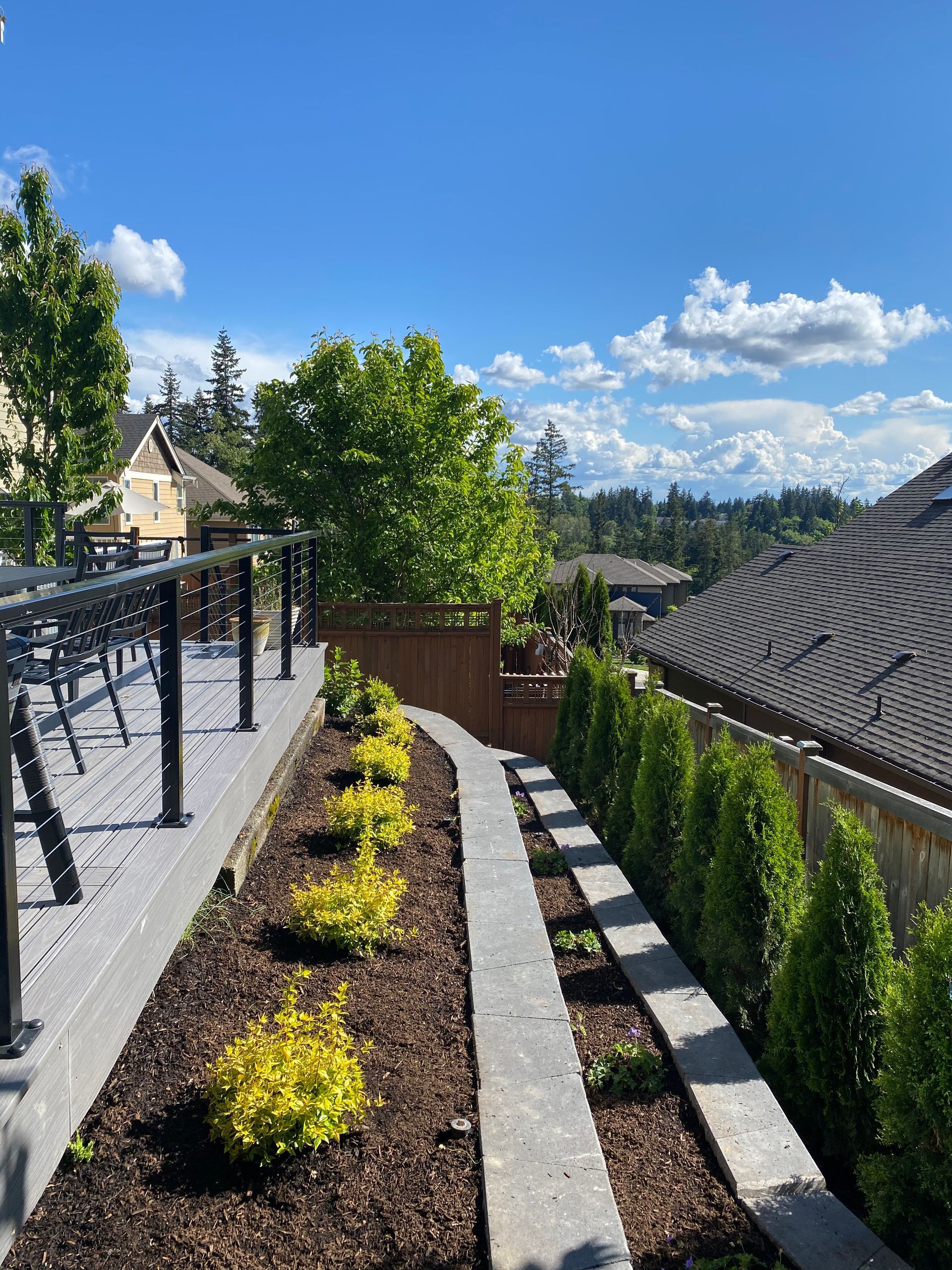
Yes. On sloped properties, which are common throughout Sammamish and Issaquah, retaining walls serve a dual role in hardscaping services for stormwater requirements: they stabilize slopes that would otherwise erode under heavy rainfall, and they create terraced planting areas that slow runoff velocity and increase the time water spends on site before reaching a drainage structure. A properly engineered retaining wall integrated into a stormwater plan is an active drainage management tool, not just a structural element.
What Is Low Impact Development and How Does It Relate to Hardscaping?
Low Impact Development (LID) is a stormwater management philosophy that treats rainfall as a resource to be managed at the source rather than a waste to be discharged as quickly as possible. LID mimics natural hydrology by using decentralized, small-scale techniques: permeable pavers, rain gardens, bioswales, green roofs, and cisterns that manage rainfall where it falls rather than routing it to centralized infrastructure.
The EPA's Green Infrastructure and LID program defines LID as the preferred stormwater management approach for new development and redevelopment in many jurisdictions, and municipalities across the Puget Sound region have aligned their local codes accordingly. Permeable hardscaping services are among the primary LID tools available to residential property owners because they replace existing impervious coverage with a system that performs like natural ground from a hydrological standpoint.
For homeowners in Seattle, Sammamish, and Issaquah, this has a direct practical implication: a permeable paver driveway or patio may count as LID compliance, qualifying the project for streamlined permitting, stormwater fee credits, or other incentives depending on the jurisdiction.
Who Can Design and Build a Combined Hardscape and Landscape Plan Using Permeable Surfaces?
Permeable pavers perform best when they are part of a holistic site design that integrates hardscape construction, landscape planting, grading, and drainage into a single coordinated plan. A contractor who handles only the paver surface without accounting for where overflow goes, how the surrounding landscape is graded, or what happens to the soil biology adjacent to the aggregate base is solving half the problem.
A design-build approach, where one team handles both hardscape drainage design and landscape installation, ensures that all site elements work together toward a common stormwater goal. Grading decisions made during hardscape construction affect where planted areas drain. Plant selections along the perimeter of a permeable paver system affect how that system performs in heavy rain. These decisions cannot be made in isolation and then handed off to a separate crew to implement independently.
For homeowners replacing an impervious concrete driveway or patio with stormwater compliant hardscaping, the full-service approach also simplifies the permitting process, since a single contractor can prepare the stormwater management plan, submit it for review, and execute the work against the approved design.
Which Permeable Paver Installation Services Offer Warranties on Materials and Drainage Performance?
Two types of warranties apply to a properly installed permeable paver system. The first is the manufacturer's material warranty on the paver units themselves, which typically runs 25 years to lifetime on concrete interlocking pavers from established manufacturers. This covers structural failure of the paver material, not installation quality.
The second, and more meaningful for hardscaping services for stormwater requirements, is the contractor's workmanship warranty covering base settlement, joint aggregate integrity, and drainage performance. These warranties typically run 2 to 5 years and are far less common than material warranties because they require the contractor to stand behind the engineering of the base system, not just the surface work.
A contractor who offers a drainage performance warranty is a contractor who has confidence in their base specification. Ask specifically whether the warranty covers drainage performance separately from surface aesthetics, and get the warranty terms in writing before signing the contract.
Stormwater Compliance Is Not Just a Regulation—It Is a Property Investment
The stormwater regulations governing hardscaping in the Puget Sound region are not going to get less strict. The trend in Washington State, King County, and individual municipalities has been consistently toward tighter standards as the cumulative impact of impervious surfaces on the watershed becomes more visible and more measurable.
Homeowners and commercial property owners who invest in hardscaping services for stormwater requirements today are making a decision that compounds in value over time. They meet current code. They future-proof against the next round of regulations. They reduce the on-site flooding and erosion risks that will only grow as rainfall intensity in the Pacific Northwest increases. And they contribute to the health of a watershed that their property value, and the quality of life in this region, depends on.
The right contractor makes the difference between a permeable paver system that performs correctly for 25 years and one that looks right but fails to drain within three. The base engineering, the soil assessment, the percolation testing, the overflow management: these are the decisions that happen before the first paver is laid and that determine the outcome of the entire investment.
The surface is what you see. The base system is what you paid for.
Whether you need a permeable paver driveway, a stormwater-compliant patio, or a full hardscape and landscape plan designed around Seattle-area stormwater requirements, MTS Tree & Landscape has the expertise to design, permit, and build it right. View our hardscaping services or call (425) 369-8733 to schedule your on-site consultation.
Frequently Asked Questions
What is hardscaping for stormwater management?
Hardscaping for stormwater management is the design and construction of hard surfaces like driveways, patios, and walkways using permeable materials and integrated drainage systems that manage rainwater on site rather than sending it to storm drains.
How do permeable pavers reduce stormwater runoff?
Permeable pavers allow rainwater to pass through gaps or porous material into a graded aggregate base where it filters and infiltrates into the native soil, reducing surface runoff by 70% to 100%.
How much does a permeable paver driveway cost?
A permeable paver driveway in the Seattle area typically costs $8,000 to $25,000 installed, depending on size, site conditions, and paver selection.
Do I need a permit for a permeable paver installation?
Most projects that alter drainage patterns or add significant hard surface area require a permit, though permeable installations may qualify for streamlined review or stormwater credits in some jurisdictions.
What is the difference between permeable and impermeable paving?
Permeable paving allows water to infiltrate through the surface into the ground, while impermeable paving sheds nearly all rainwater as surface runoff.
How does grading affect stormwater management in hardscaping?
Proper grading directs overflow away from structures and toward designated infiltration or drainage zones, and is the foundation of any effective stormwater hardscape design.
What is low impact development?
Low impact development (LID) is a stormwater management approach that uses decentralized techniques like permeable pavers, rain gardens, and bioswales to manage rainfall where it falls, mimicking natural hydrology.
Do retaining walls help with stormwater management?
Yes, retaining walls control slope erosion, manage water flow direction, and create terraced areas that slow runoff velocity on sloped properties.
How do French drains work with permeable hardscaping?
French drains collect excess subsurface water through a perforated pipe in a gravel trench and redirect it away from structures, serving as overflow management for permeable paver systems on slow-draining soils.
How often do permeable pavers need maintenance?
Permeable pavers require periodic joint cleaning and joint aggregate replenishment, typically once every 1 to 3 years depending on site conditions and debris accumulation.
Can permeable pavers handle vehicle traffic on driveways?
Yes, interlocking permeable concrete pavers (PICP) installed on a properly engineered aggregate base are rated for residential and commercial vehicle loads including passenger cars, trucks, and delivery vehicles.
You might also like