Emergency Tree Service: 24/7 Response Times, What to Expect & How to Prepare
A true emergency tree service responds around the clock—not just during business hours. When a tree falls on your roof, blocks your driveway, or leans dangerously toward a power line, you need a licensed, insured crew on-site fast. Most reputable companies reach you within one to four hours of your call, though major storms can extend that window. Your homeowners' insurance may cover removal costs if a structure was damaged—document everything before the crew arrives. If you're in the Seattle, Sammamish, or Issaquah area and need immediate help, MTS Tree & Landscape provides 24/7 emergency tree service backed by certified arborists, owned heavy equipment, and full insurance coordination.
What Is Considered an Emergency Tree Service?
Not every tree problem is an emergency. A dead limb hanging over your garden is a concern worth scheduling. An uprooted tree resting against your bedroom wall is a different matter entirely.
Emergency tree service refers to any urgent response to a tree (or part of a tree) that poses an immediate threat to people, structures, utilities, or access routes. It operates outside normal business hours and is prioritized based on hazard level , not calendar availability.
Situations that qualify as true tree emergencies include:
- A tree or large limb that has fallen on a house, garage, fence, or vehicle
- A tree actively leaning toward a structure, power line, or public road after a storm
- A fully uprooted root ball heaving pavement or threatening a foundation
- A tree or limb blocking road access, a driveway, or emergency vehicle routes
- Any tree in contact with or tangled in overhead power lines
- A storm-split trunk with hanging "widow-maker" limbs over occupied areas
When to Call Immediately: If a tree has fallen on a structure, is leaning toward a home or power line, or is blocking emergency vehicle access, it qualifies as an urgent tree removal situation requiring same-day or same-hour response.
A dangerously leaning tree after a storm is never a "wait and see" situation. Root failure can be silent—the tree may look stable and fall without warning hours later. If the lean appeared suddenly during high winds or saturated ground, treat it as an emergency until a certified arborist tells you otherwise.
For broader guidance on storm-related property damage, FEMA's storm damage recovery resources are a useful reference point.
Who Do You Call When a Tree Falls on Your House?
This is not the time to search the web and comparison shop. The sequence of calls you make in the first thirty minutes matters.
Step-by-Step: What to Do and Who to Call First During a Storm
- Get everyone out of the affected area. If a tree has breached the roof or wall, evacuate that part of the home. Structural integrity after impact is unpredictable.
- Call 911 if anyone is injured, trapped, or if there is immediate danger to life.
- Contact your utility company if power lines are involved or if the tree may have struck electrical infrastructure. For Seattle-area homeowners, that's Puget Sound Energy. Do not approach downed lines for any reason.
- Photograph and video everything —the fallen tree, point of contact, interior damage if accessible, and the surrounding area. Do this before any cleanup begins. Your insurance claim depends on it.
- Call a licensed, insured emergency tree removal company. This is your next call, not your last.
- Contact your homeowners' insurance provider to open a claim and ask about your deductible and documentation requirements.
If you're in the Seattle, Sammamish, or Issaquah area and need immediate help, call MTS Tree & Landscape at (425) 369-8733 for 24/7 emergency tree removal.
How Quickly Can an Emergency Tree Service Respond?
Most reputable emergency tree services reach the site within one to four hours of an initial call. That range isn't vague—it reflects real variables that affect dispatch time even for crews already standing by.
What Factors Affect Emergency Response Times?
| Factor | Faster Response | Slower Response |
|---|---|---|
| Weather conditions | Isolated incident, passable roads | Active storm, widespread debris blocking routes |
| Time of day | Business hours | Overnight (though 24/7 services still respond) |
| Hazard level | Imminent structural threat, life safety | Tree down in open yard, no structure contact |
| Location accessibility | Clear driveway, open lot | Gated property, steep slope, narrow access |
| Crew availability | Low-demand period | Peak storm season with multiple concurrent calls |
During widespread storm events (the kind that knock trees down across an entire region in one night), even the most well-staffed companies triage by hazard severity. A tree on a roof gets a crew before a tree across an empty driveway. That's not negligence; that's responsible prioritization.
Same-day service is standard for genuine emergencies under normal conditions. For situations where there's no structural contact and no utility involvement, next-day arrival is sometimes appropriate—and an honest company will tell you that rather than upsell urgency.
Who Offers Reliable 24-Hour Emergency Tree Service Near Me?
The phrase "24/7 emergency tree service" appears on a lot of websites. Fewer companies actually back it up with on-call crews, owned equipment, and someone who physically answers the phone at 2 AM.
How to Find a Licensed and Insured Emergency Tree Removal Company
Before authorizing any work, verify the following:
- Washington State contractor license —confirm the company is registered with Labor & Industries. This is non-negotiable.
- General liability insurance —at minimum $1 million per occurrence. Ask for a certificate of insurance, not just their word.
- Workers' compensation coverage —if an uninsured crew member is injured on your property, you may bear liability.
- ISA certification —the International Society of Arboriculture credential signals that at least one crew member has met a professional standard for tree care knowledge and safety.
- Google reviews and BBB standing —look for a consistent record, not a handful of reviews that all appeared in one week.
- Owned heavy equipment —companies that rent cranes and bucket trucks on short notice during storm events often face delays and higher costs.
When a tree falls on your house during a storm at 11 PM, you don't have time to vet five companies from scratch. That's why it's worth identifying a reliable local provider before storm season hits.
MTS Tree & Landscape is fully licensed, insured, and ISA-certified— contact us to verify credentials or request immediate service.
How Much Does Emergency Tree Removal Cost?
Emergency tree removal typically costs $500 to $5,000 or more, with most residential jobs falling somewhere in the middle of that range. The wide spread isn't a dodge—it reflects genuinely different job conditions.
Emergency Tree Removal Pricing: What Drives the Cost?
| Cost Factor | Impact on Price |
|---|---|
| Tree diameter (DBH) | Larger trees require heavier equipment and more labor hours |
| Location—structure vs. open ground | Structural contact requires crane work and precision rigging |
| Power line involvement | Utility coordination required; only line-clearance certified crews can proceed |
| Time of service (after hours, weekends, holidays) | After-hours premium is typically 1.5x–2x the standard rate |
| Access difficulty | Tight yards, slopes, and rear-of-property trees add complexity |
| Debris volume and haul-away | Full cleanup vs. cut-and-leave changes the total significantly |
Important: Emergency tree removal typically costs two to three times more than a scheduled removal due to urgency premiums, hazard complexity, and after-hours labor. Always request a written estimate before authorizing work —a reputable company will provide one even under urgent conditions.
The honest answer to "Is emergency tree removal more expensive?" is yes, and it should be. Crews are mobilizing outside normal hours, sometimes in hazardous conditions, with equipment that costs real money to operate and insure. What you're paying for is response, expertise, and safety.
Does Homeowners Insurance Cover Emergency Tree Removal?
In most cases, yes—if the tree damaged a covered structure. Most standard homeowners policies cover emergency tree removal when the fallen tree strikes your home, detached garage, fence, or another covered structure.
If a healthy tree falls into your yard and damages nothing, most policies will not cover removal. If a neighbor's tree falls onto your structure, your own policy typically handles it—and your insurer pursues the neighbor's if negligence can be established.
For a detailed breakdown of standard homeowners policy coverage, the Insurance Information Institute is a reliable reference.
Practical tips for working with your insurer:
- Photograph everything before any debris is moved. Adjusters need to see original conditions.
- Keep receipts for any emergency tarping, temporary repairs, or overnight lodging if the home was uninhabitable.
- Ask your tree service whether they document damage and work directly with insurance adjusters—many experienced companies do this routinely.
- Know your deductible before you authorize work. If the removal cost is close to your deductible, filing a claim may not be worth it.
What Questions to Ask Before Authorizing Emergency Tree Removal
Before you sign anything, ask these questions:
- Are you licensed and insured? Ask for a certificate of insurance on the spot.
- Will you provide a written estimate? Verbal quotes become disputes. Get it in writing.
- What exactly is included in the quoted price? Stump grinding, debris haul-away, and cleanup are often separate line items.
- Is stump removal included, or is that additional? Many emergency quotes cover the tree only. See our stump removal service page for what to expect.
- Do you work directly with insurance adjusters? This saves time and reduces documentation errors.
- Is there an after-hours premium, and how is it calculated?
- What happens if the scope of work changes once you're on-site? How are overages communicated and approved?
- Who are the actual workers—your employees or subcontractors? Subcontractor arrangements can complicate liability.
What Is Typically Included in an Emergency Tree Service Visit?
The scope of an emergency tree service visit depends on whether you're receiving emergency stabilization or full removal and cleanup. These are often two separate phases, and understanding the difference prevents mismatched expectations.
Emergency Stabilization vs. Full Tree Removal and Cleanup
| Service Phase | What's Included | Typical Timeframe |
|---|---|---|
| Emergency Stabilization | Hazard removal, tarping exposed roof areas, clearing primary access points | 1–4 hours on-site |
| Full Removal | Complete tree sectioning, limb removal, log haul-away | Same day or next day depending on scale |
| Site Cleanup | Debris chipping, stump grinding, yard restoration | 1–3 days post-event |
The first visit is often about making the scene safe—getting the weight off the roof, clearing the road, removing the immediate hazard. A second visit completes the removal and cleanup once conditions allow.
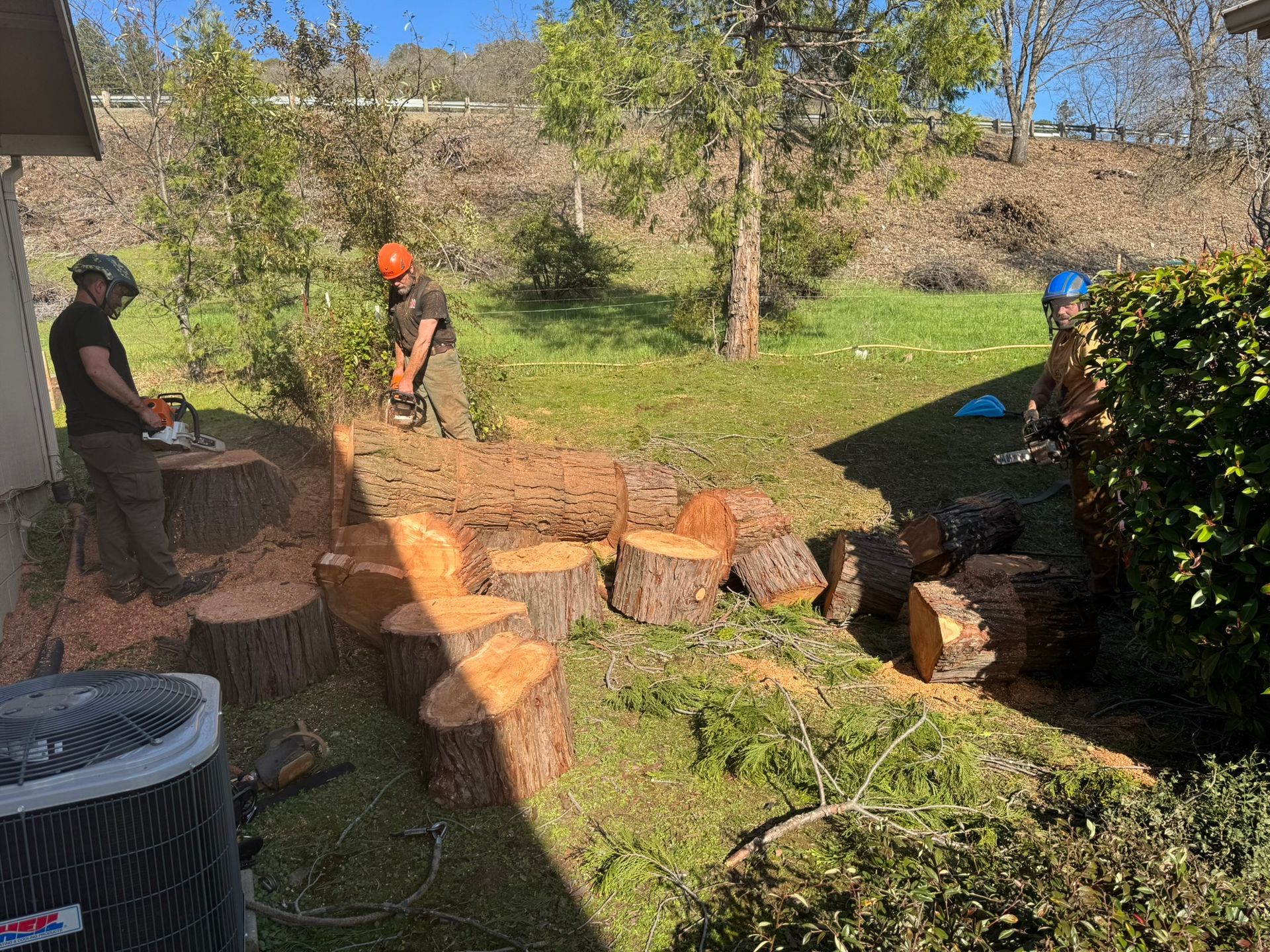
As for equipment: emergency tree crews typically deploy chainsaws, cranes, bucket trucks, wood chippers, stump grinders, and rigging systems. The specific combination depends on the job. A tree across a driveway with no overhead hazards needs different equipment than a tree lodged against a chimney over a finished living space.
Most full-service tree companies also offer comprehensive storm cleanup as a follow-up service—debris removal, limb chipping, log haul-away, and site restoration. If you've had a significant weather event, it's worth asking about storm cleanup scope when you call.
Can Emergency Tree Services Remove Trees Near Power Lines?
This is one of the most important safety questions homeowners ask—and the answer is more nuanced than most expect.
Never approach a downed tree that is in contact with or near a power line. Assume every downed line is energized. The voltage capable of traveling through a fallen tree, wet ground, or metal fencing is lethal. Distance does not guarantee safety.
Safety Notice: If a tree is touching or near a power line, call 911 and your utility provider first. Do not approach the tree, the line, or the ground immediately surrounding either. A qualified emergency arborist will coordinate directly with the utility company before any removal work begins.
Under OSHA electrical safety standards, only line-clearance certified arborists are authorized to work within ten feet of energized conductors. General tree crews—even experienced ones—are not permitted to operate in that zone. A legitimate emergency tree service knows this and will tell you so plainly.
The process works like this: the utility de-energizes the line, the certified crew performs the removal under specific protocols, and utility workers restore power after the scene is clear. It takes longer than a standard removal, but there is no safe shortcut.
If a tree has brought down a line across your yard, your first call is to your utility company and 911—not a tree service. Once the utility confirms the line status, your emergency arborist can assess next steps.
How to Prepare Your Property Before an Emergency Tree Crew Arrives
A few minutes of preparation before the crew arrives makes a real difference—both for safety and for documentation.
- Clear vehicle access. Move cars, trailers, and any moveable equipment away from the affected area. Emergency crews need room for trucks, chippers, and cranes.
- Secure pets indoors. Chainsaws, falling debris, and unfamiliar workers are stressful for animals—and a loose dog near an active work zone is a genuine safety hazard.
- Photograph and video all damage from multiple angles before anything is moved. Walk the perimeter. Document interior damage if safely accessible.
- Locate your homeowners insurance policy. Have your policy number, agent's name, and the claims phone number ready before you make that call.
- Mark underground utilities or irrigation lines if you know where they run. Crews doing stump grinding or ground-level work need to know what's below the surface.
- Identify the tree species if you can. Knowing whether it's a Douglas fir, red alder, or big-leaf maple helps the crew anticipate wood density, root structure, and debris volume.
- Note any recent changes —unusual lean, visible root heaving, bark damage, or signs of decay. Tell the arborist what you observed before the storm.
Can I Remove a Fallen Tree Myself or Do I Need a Professional?
Small brush and minor limbs—possibly manageable with the right tools and careful judgment. Anything beyond that is a different conversation.
Small, accessible debris with no tension or structural involvement can sometimes be handled by a careful homeowner with the right equipment and experience. But most fallen-tree situations don't fit that description.
When DIY Tree Removal Becomes Dangerous
Never Attempt DIY Removal When:
- The tree is in contact with any power line or utility infrastructure
- The trunk diameter exceeds 6 inches
- The tree is resting on a structure—roof, fence, vehicle, or shed
- Limbs are visibly bent, twisted, or under tension (spring-loaded wood releases without warning)
- The tree is "hung up" in another tree, with weight distributed unpredictably
- You do not own or are not trained to operate a chainsaw safely
Chainsaw kickback, spring-loaded limbs, and shifting weight from a trunk resting on a structure are the three most common causes of serious injury in amateur tree removal attempts. These are not theoretical risks —they send people to emergency rooms every year.
If a tree falls on your car, the same logic applies. Move to safety, call 911 if the road is blocked, document with photos, contact your auto insurance provider, and then call a professional emergency tree removal company. Don't attempt to move the tree off the vehicle yourself.
Who Is Responsible for a Fallen Tree Between Neighbors?
The general rule in most U.S. jurisdictions, including Washington State: the property owner where the tree lands is typically responsible for cleanup and the insurance claim —regardless of where the tree was rooted.
That means if your neighbor's healthy tree falls into your yard during a storm, your homeowners insurance handles the removal. Your insurer may then pursue the neighbor's policy through a process called subrogation if there's a recoverable liability.
The exception involves prior notice of a hazardous condition. If you have documented written communication telling a neighbor their tree was diseased, dead, or structurally compromised—and they failed to act—they may bear liability for the resulting damage. This shifts into legal territory quickly, and a consultation with an attorney is the appropriate next step for disputed situations.
What a tree service can and cannot do: provide documentation of the work performed and the condition of the tree. What they can't do is resolve a legal dispute between property owners. Keep that distinction clear.
Which Local Tree Companies Provide Priority Emergency Response for Downed Trees?
The difference between a company that markets emergency service and one that actually delivers it comes down to infrastructure, not just availability.
A true 24/7 emergency tree service has:
- Dedicated on-call crews —not a single dispatcher forwarding calls to whoever is available
- Owned heavy equipment —cranes, bucket trucks, and chippers on standby, not rented from a third party during peak demand
- Established relationships with local utilities —which is what allows faster coordination when power lines are involved
- Storm-response protocols —crew call trees for prioritization, equipment staging, and multi-site coordination
- Local knowledge —familiarity with soil conditions, tree species, neighborhood access patterns, and permit requirements in Seattle, Sammamish, Issaquah, and Bellevue
After-hours emergency support for a dangerously leaning tree is exactly the scenario where that infrastructure matters. A company scrambling to locate a crane at midnight is not the company you want.
MTS Tree & Landscape maintains dedicated emergency crews and heavy equipment across the Seattle, Sammamish, and Issaquah service areas. For 24/7 storm damage tree removal and urgent tree cutting, call (425) 369-8733 or request service online.
Are Emergency Tree Removal Services Available 24/7?
Reputable emergency tree services operate around the clock—but "available" means different things depending on the situation.
A legitimate 24-hour tree service has someone answering the phone at 3 AM. That person assesses the hazard, documents the call, and either dispatches a crew immediately for life-safety situations or schedules the earliest possible response for high-priority, non-life-threatening situations.
For after-hours tree service, genuine emergencies—a tree on a roof, a tree blocking road access, a tree on a power line—get crew dispatch regardless of the hour. A tree that fell in the back yard and damaged no structure may be triaged for first-light response. Honest companies will tell you this upfront.
What to avoid: companies that list an emergency number on their website that routes to voicemail after 6 PM. Ask directly: "If I call this number at 2 AM, does a person answer?" The answer tells you everything.
When Every Hour Matters, Preparation Is Your Best Defense
The homeowners who fare best during tree emergencies are almost never the ones who acted fastest in the moment—they're the ones who prepared before the storm hit.
We've seen it repeatedly: a family in Sammamish loses half a Douglas fir to a wind event, and because they had a licensed tree company's number already saved, their insurance documentation organized, and a general understanding of the process, the situation gets resolved efficiently. Contrast that with a homeowner making frantic calls to unlicensed crews at midnight, authorizing work without written estimates, and discovering three weeks later that the costs weren't covered because documentation was incomplete.
The practical steps are straightforward.
Know your homeowners insurance policy—specifically what structures are covered and what your deductible is. Verify the licensing and insurance of any tree company you'd consider calling before you need them. Understand that power line situations require utility coordination, not DIY intervention. And if you've had an arborist assess any mature trees on your property for structural concerns, keep that documentation—it matters for insurance and for neighbor liability conversations.
Emergency tree service is not complicated when the right people are involved. It becomes complicated when homeowners are making high-stakes decisions without information, under pressure, in the middle of a crisis.
When a tree emergency strikes in the Seattle, Sammamish, or Issaquah area, MTS Tree & Landscape provides the fast, insured, professional response your property needs. Save our number now—call (425) 369-8733—or reach out through our contact page to discuss your situation with a certified arborist.
Frequently Asked Questions
What is considered an emergency tree service?
An emergency tree service is any urgent response to a fallen, damaged, or dangerously leaning tree that poses an immediate threat to people, structures, or utilities.
How much does emergency tree removal typically cost?
Emergency tree removal typically ranges from $500 to $5,000 or more depending on tree size, location, hazard level, and whether after-hours labor is required.
Who do you call when a tree falls on your house?
Call 911 if anyone is in danger, then contact your utility company if power lines are involved, followed by a licensed emergency tree removal service and your homeowners insurance provider.
Does homeowners insurance cover fallen tree removal?
Most homeowners insurance policies cover tree removal when the tree damages a covered structure, but generally do not cover removal if the tree falls without causing structural damage.
How quickly can an emergency tree service respond?
Most reputable emergency tree services respond within one to four hours, though severe storm events with widespread damage may extend response times.
What should I do if a tree falls on my car?
Move to safety, call 911 if the road is blocked, document the damage with photos, contact your auto insurance provider, and then call a professional emergency tree removal company.
Can arborists safely remove trees near power lines?
Only line-clearance certified arborists are authorized to work near energized power lines, and they coordinate directly with the utility company before beginning removal.
Is emergency tree removal more expensive than scheduled removal?
Yes—emergency tree removal typically costs two to three times more than scheduled service due to urgency, hazard premiums, specialized equipment, and after-hours labor rates.
What equipment is used for emergency tree removal?
Emergency tree crews commonly use chainsaws, cranes, bucket trucks, wood chippers, stump grinders, and rigging systems depending on the complexity of the job.
Do tree services offer storm cleanup?
Yes, most full-service tree companies offer comprehensive storm cleanup including debris removal, limb chipping, log haul-away, and site restoration.
How do I prepare for emergency tree removal?
Clear vehicle access to the tree, secure pets indoors, photograph all damage for insurance documentation, and locate your homeowners insurance policy information before the crew arrives.
You might also like